Gardening Euston: Recycling and Sustainability
 At Gardening Euston we prioritise an eco-friendly waste disposal area and a sustainably managed rubbish gardening area that supports greener streets and healthier soil. Our approach balances practical on-site operations with borough-level waste strategies so that every cut branch, soil lift and pot can be treated as a resource rather than refuse. We work to embed reuse, repair and separation into everyday garden care, reducing waste streams and helping Euston become a low-waste neighbourhood.
We design our site to be an efficient and low-impact hub for garden material recovery: clear sorting bays, sheltered composting bays for woody and leafy matter, and designated storage for reusable pots, reclaimed timber and gently-used tools. This sustainable rubbish gardening area is built to integrate with local services and to make source-separated collections simple for our crews and partners. It also means less contamination and a higher quality of recyclable material sent on to reuse or processing.
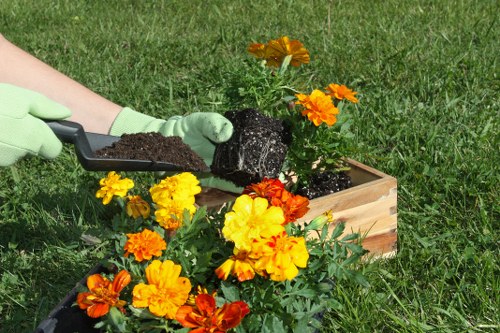 Our ambitions include an explicit recycling percentage target: we aim to achieve a 65% operational recycling rate across all Gardening Euston activities within three years, with a parallel target to divert 85% of green and organic garden waste away from landfill through composting, anaerobic digestion partnerships and material reuse. These targets are practical, measurable and aligned with wider borough goals for reduced landfill and higher resource recovery.
H2: Local transfer stations and civic amenity links
We coordinate with nearby transfer stations and civic amenity sites so that collected materials follow the most efficient route from garden to processor. By mapping local transfer facilities in Camden and neighbouring boroughs, our crews minimise mileage and ensure organic material goes to composting or anaerobic digestion facilities while timber, metals and inert soils go to appropriate reprocessing sites. Working with these local transfer stations reduces double-handling and keeps our carbon footprint low.
Partnerships with charities and community reuse
Gardening Euston cultivates strong relationships with local charities, community projects and reuse social enterprises. Through partnerships we:
- Donate usable pots, raised-bed timber and greenhouse panels to community gardens and household reuse initiatives.
- Work with food redistribution and community growing groups to convert surplus soil and compost into resources for local allotments.
- Support repair and reuse workshops by directing gently worn tools and fixable equipment to social enterprises rather than disposing of them.
 Our charity partnerships emphasise social value as much as environmental value: we prioritise local redistribution of materials so that reuse benefits Euston residents directly. These collaborations extend the life of materials, reduce demand for new goods and foster circular economy practices in the neighbourhood.
Fleet and logistics: low-carbon vans and active transport
We operate a growing fleet of low-carbon vans, electric vehicles and pedal-assisted cargo bikes for short-distance work in the Euston area. This mixed fleet approach minimises emissions from collections and enables nimble transportation into pedestrian or congested areas where larger vehicles are impractical. Where diesel or hybrid vehicles are still required for heavy loads, we use the latest efficient models and maintain strict idling policies to reduce local air pollution.
To further reduce scope-1 emissions we plan route optimisation, consolidate trips to transfer stations and schedule multi-drop collections that group recyclable materials by destination. This increases vehicle efficiency and supports our recycling percentage target by ensuring materials are taken straight to the right processing facility.
Operational separation and borough coordination
Gardening Euston aligns day-to-day separation with the borough’s approach to waste separation: source-separate organics, mixed dry recycling and designated residual collections. By mirroring local kerbside schemes we make it easier for residents and businesses to understand what should be collected on-site and what should be left for municipal collection. Our crews are trained to spot contamination and to re-sort materials on-site, improving the quality of recyclate passed on to processors.
Specific recycling activities relevant to the area include:
- Green waste composting and wood-chipping for mulch and biomass recovery.
- Food-waste collection coordination with AD (anaerobic digestion) partners.
- Separation of soil and inert aggregates for reuse in landscaping projects.
- Reuse of pots, planters and reclaimed timber through charity partnerships.
- Segregation of metals, plastics and glass for local recycling streams.
 Monitoring, reporting and continuous improvement are central to our sustainable site design. We publish internal progress against our recycling targets, measure tonnes diverted, and review fleet emissions quarterly. This data-driven approach lets us refine on-site sorting configurations, increase turnaround at transfer points and identify new charity or social enterprise partners for material reuse.
 In summary, Gardening Euston embeds sustainability into every aspect of garden care — from our eco-friendly waste disposal area to a resilient, sustainable rubbish gardening area that champions reuse, local partnerships and low-carbon logistics. Our targets, local transfer station links, charity collaborations and low-emission fleet combine to create a practical model of urban garden waste management that supports the wider borough ambitions for a circular, low-carbon future.
Together we transform garden waste into resources, reduce emissions and strengthen community resilience — that is the Gardening Euston promise.